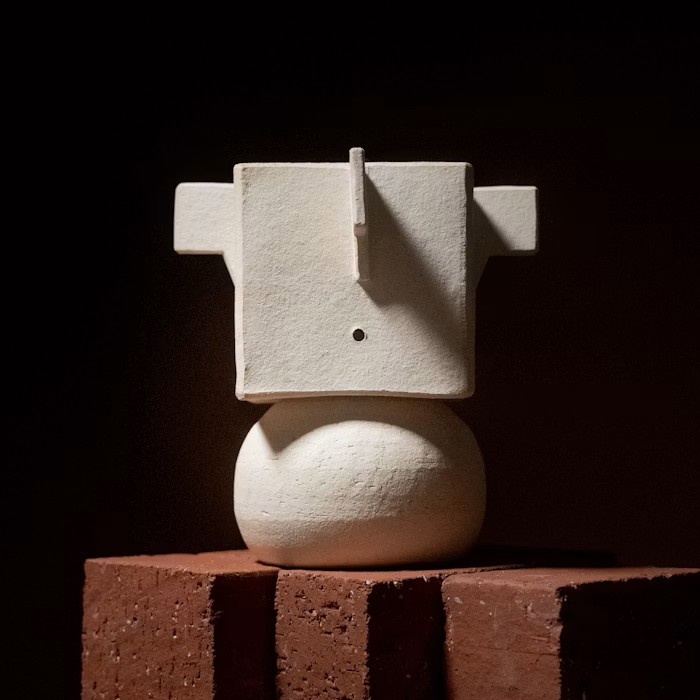
The Vessel and the Void
Ceramic work taught me something that painting could not: that the interior of a form is as meaningful as its exterior…
When I first moved into three-dimensional work, I was resistant. Painting had given me everything — surface, colour, time, accumulation. What could volume offer that a painted plane could not?
The answer turned out to be: the inside.
A ceramic vessel encloses space. It creates an interior that is completely separate from the world outside the form, yet dependent on the form for its existence. The void inside the bowl is not nothing — it is a specific nothing, shaped by the walls that define it.
This is philosophically different from anything I could do on a flat surface. A painting has no interior. Its depth is always optical, always a kind of fiction. The ceramic vessel has actual depth — an inside that the eye cannot easily reach.
I think about this in relation to the body. The body is also a vessel. It encloses something — consciousness, breath, the fact of being alive — within a form. The ceramic work is, in part, a meditation on this enclosure. What it means to be bounded. What it means to hold something.
The celadon glaze I use on the Vessel series is important here. Celadon is traditionally associated with jade — with things that appear to be both solid and luminous, opaque and transparent at once. I want the glaze to complicate the boundary between inside and outside. To make it shimmer.